
During last week’s testing on the FESTO CP assembly line the importance of traceability of parts was highlighted, due to the tests being conducted whilst others were also using the equipment to process visually similar parts. Without close inspection it was not possible to tell one phone case back from another, this could have easily led to confusion over which who’s parts were succeeding or failing. Indeed, even were there no other users at the time of testing, being unable to identify revisions of the part would become an issue as their performance is tested. Furthermore, once the design and and printing settings are finalised it is still important to be able to identify parts in order to discern the cause of problems should they arise.
In more general terms traceability in manufacturing is important for several reasons:
- Quality Assurance: Traceability enables manufacturers to track and monitor the entire production process, from raw materials to finished products. This ensures that quality standards are maintained and allows for quick identification and resolution of any issues or defects that may arise.
- Compliance: Many industries have strict regulations and standards governing the production and distribution of goods. Traceability systems help manufacturers demonstrate compliance with these regulations by providing detailed records of materials used, production processes, and product distribution.
- Safety: In sectors such as food, pharmaceuticals, and aerospace, traceability is critical for ensuring the safety of consumers. By tracing the origin of ingredients or components, manufacturers can quickly identify and recall products that may pose a health or safety risk.
- Efficiency: Traceability systems improve operational efficiency by providing insight into production processes, identifying bottlenecks, and optimizing workflows. This enables manufacturers to streamline operations, reduce waste, and improve overall productivity.
In the case of this product for Phones-R-Us, traceability is particularly relevant since they are outsourcing production to multiple suppliers. If there are any issues with the components, it is important that the supplier can be quickly and reliably identified.
During the prototyping stage it has been decided to include a unique serial number on each revision of the phone case. This will be applied manually at the end of the slicing setup in the slicing software. It will be a simple two digit sequence prefixed by TLW, thus enabling the identification of the part and the supplier. As shown below, it will be engraved on the inside surface of the part: this is to prevent it from being visible from the outside of the final product and it is also placed so as to not interfere with any other components.
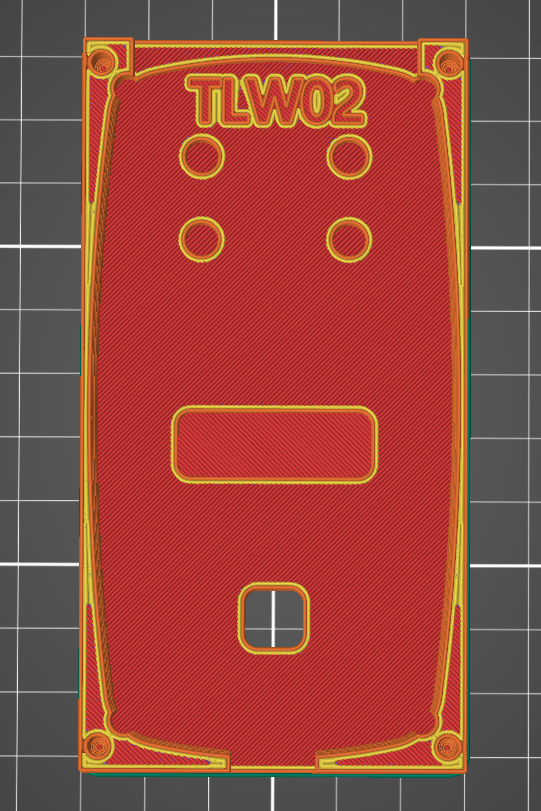
Once the design is finalised and enters production a more extensive code will be required so as the part can be traced back to the machine that printed it and the time. This will take the following format: TLW-PP-#####, in the place of the “PP” will be the printer’s code (each printer will be assigned one), and in the place of “#####” will be a five digit number indicating which print in the sequence it is.
Next week will see the subsequent prototype case tested.
 TL Weston